If you haven't heard the term yet, you will. It's the discipline that separates AI prototypes that impress in demos from AI systems that work reliably in production. And if your organization is evaluating AI investments, building AI tools, or trying to figure out why your AI initiative hasn't delivered what you expected, context engineering is probably where the answer lives.
Here's what it is, why it matters, and what it means for how your team should be thinking about AI.
The Shift: From "How Do I Ask?" to "What Does It Need to See?"
For the past two years, the dominant conversation in AI has been about prompts: how to phrase requests, how to structure instructions, how to "talk" to an AI model to get better results.
Prompt engineering is real. Crafting clear, specific instructions matters. But practitioners building production AI systems discovered something prompt optimization alone couldn't solve: the way you phrase a request often matters less than what information the model can see when it processes that request.
This distinction is subtle but has major strategic implications.
Prompt engineering asks: "How do I phrase this request to get a better answer?"
Context engineering asks: "What does the model need to see to give the right answer?"
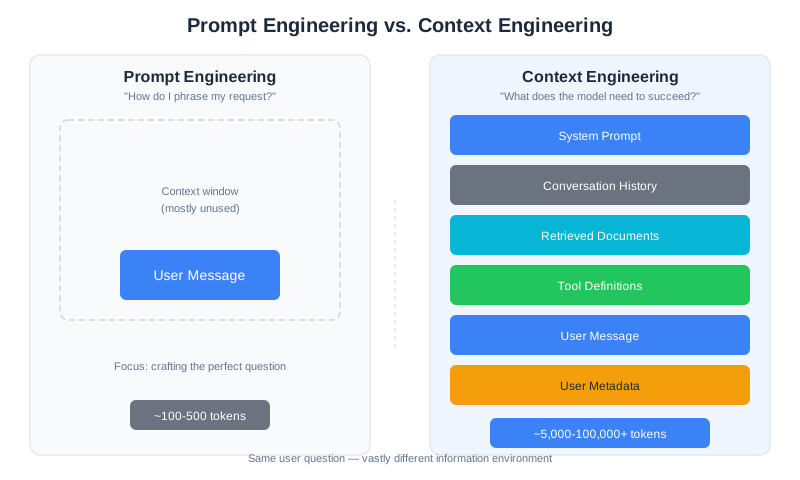
Andrej Karpathy, one of the founders of OpenAI and former AI director at Tesla, described context engineering as "the delicate art and science of filling the context window with just the right information for the next step." Anthropic's engineering team called it "finding the smallest possible set of high-signal tokens that maximize the likelihood of some desired outcome."
Both definitions focus on information, not on phrasing.
The Anthropic team also described context engineering as "the natural progression of prompt engineering." This is important: it's an evolution, not a replacement. Prompt skills remain useful. But context engineering is the bigger lever.
Here's the practical implication for your organization: when an AI system gives wrong, inconsistent, or unhelpful answers, the instinct is usually to change the prompt. The more powerful diagnosis is to ask what information the model had, or didn't have, when it generated that answer.
Where This Term Fits in the Landscape
You've probably encountered a few overlapping terms. A quick orientation:
- Vibe coding: a development approach where builders collaborate with AI through iterative conversation to create software quickly. Great for prototypes.
- Prompt engineering: the discipline of crafting effective instructions for AI models. Foundational, still essential.
- Context engineering: the evolution of prompt engineering: what information reaches the model, in what form, at what time.
- Agentic engineering: building systems where AI agents take autonomous, multi-step actions. Context engineering is the core competency here, because an agent is only as capable as the information it can see.
These aren't stages you leave behind. They coexist. Context engineering is the discipline that makes everything else work reliably.
The Five Components Your Team Is Probably Ignoring
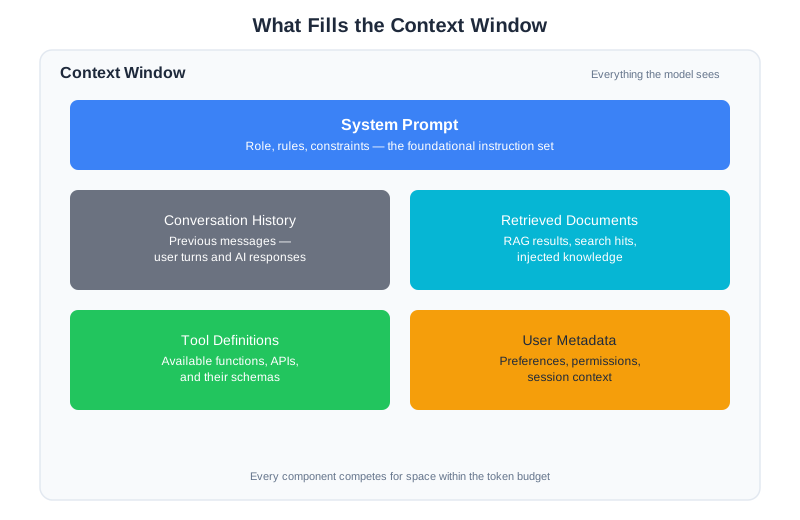
When your team sends a message to an AI model, they're not just sending a message. They're sending a context window, a package of information the model sees when it generates a response.
Think of it as handing someone a folder of documents before asking them a question. The contents of that folder shape the answer as much as the question itself. That folder has five main components:
1. The System Prompt
The foundational instructions that define who the AI is and how it should behave. Most organizations treat this as a throwaway sentence. Production systems treat it as a serious, iterated document, often thousands of words long, that establishes the AI's role, constraints, and rules. In consumer-grade AI tools, you don't see it. In any AI system your team builds, it's one of the most important things you'll write.
2. Conversation History
Every prior message in an ongoing exchange. This is what allows AI to maintain coherence across a long conversation: it can see what was said before. But it has a cost: every message consumes space that could hold other useful information. A long conversation can crowd out everything else the AI needs.
3. Retrieved Documents
When AI systems search through databases, knowledge bases, or internal documents before responding, those retrieved results get included in the context. This is the foundation of what's called RAG (Retrieval-Augmented Generation): giving AI access to information it wasn't trained on. The quality of what gets retrieved often matters more than anything else. The right documents with a mediocre prompt will outperform the wrong documents with a perfect one.
4. Tool Definitions
Modern AI systems can use tools: search the web, query a database, run calculations, call an API. The model needs to know what tools are available and how to use them, and those definitions are part of the context. Every tool you add to an AI system uses space, even when the tool isn't being called.
5. User Metadata
Information about the person asking: their role, preferences, history, current context. This is the personalization layer. An AI assistant that knows a user is a senior manager will respond differently than one that thinks it's talking to a new employee. Small input, often large impact on response quality.
The key insight most organizations miss:
Teams building AI systems typically think about one or two of these components, usually the system prompt and whatever the user typed. Production systems need all five working together, deliberately designed.
This is the difference between "our AI sometimes gives good answers" and "our AI reliably gives good answers."
Why This Matters for Your AI Investment
Leaders evaluating AI often spend disproportionate time on model selection. GPT-4o vs. Claude vs. Gemini. Which benchmark wins? Which vendor has the best pricing?
Model selection matters less than most leaders think. Context architecture matters more. Here's the evidence:
GitHub Copilot
Had a hallucination problem. The breakthrough wasn't switching models. It was redesigning what information the model could see: project-specific instruction files, recent edit history, similar code from elsewhere in the codebase. Developers using Copilot completed tasks up to 55% faster in controlled studies. The model didn't change. The context did.
Notion's AI
Hit a wall with complex tasks. Their solution was to shift from one large context holding everything to specialized agents with focused, small contexts. Response latency dropped from over 10 seconds to under 3. Error rates on complex tasks improved by an order of magnitude. Again: the model didn't change. The context architecture did.
SK Telecom
Needed AI to answer telecom-specific questions accurately. The base model answered roughly 40% of those questions correctly. After building a retrieval system that injected the right internal documents for each query, accuracy exceeded 90%. The fix wasn't a better model. It was better context.
The pattern is consistent across organizations: the teams getting AI right are treating context as infrastructure, something designed, measured, and iterated on, not an afterthought.
The strategic implication:
Your AI initiative probably isn't stuck because you chose the wrong model. It's stuck because the information reaching the model isn't designed for the task you're asking it to do. That's an engineering problem with an engineering solution.
Two Applications, One Discipline
Context engineering applies to your AI strategy in two directions that are worth distinguishing.
If you're building AI systems, customer-facing AI, internal tools, automation workflows, you're designing what information reaches the model. Every decision about what's in the system prompt, what gets retrieved, what tools are available, what user context is included: that's context engineering. The quality of these decisions determines whether your AI system is something users trust or something they work around.
If your team is using AI tools, Cursor, GitHub Copilot, Microsoft Copilot, or other AI-assisted tools, they're doing context engineering whether they know it or not. How a developer structures a project affects how well AI can navigate it. What files are open when a query is made affects what the AI can reference. Whether someone starts a fresh session or continues a degraded one affects response quality.
This second application is underappreciated. There's an open standard called AGENTS.md, a file format for giving AI coding tools project-specific context, that has been adopted by more than 40,000 open-source projects. These developers are practicing context engineering without necessarily using the term. They've discovered that giving AI tools the right information about a project produces dramatically better results.
The same principle applies whether you're a developer, an analyst, or an executive using AI to draft communications: the context you establish before asking determines the quality of what you get back.
The Right First Question for Any AI Initiative
If your organization is starting an AI project, or has started one and hit a wall, the question that unlocks progress usually isn't "which model should we use?" or even "what should we prompt it to do?"
The right first question is: What does the model need to see to succeed at this task?
That question reframes the entire problem. It shifts focus from phrasing to information architecture. It moves the conversation from model selection to context design. And it gives your team a diagnostic framework when things don't work: not "how do we rewrite the prompt?" but "what was missing or wrong in the context?"
This is the difference between organizations that have impressive AI demos and organizations that have reliable AI systems in production.
Go Deeper: Context Engineering
For the full technical deep dive, including how context windows work mechanically, where performance degrades, and how to engineer each of the five components, read Chapter 1 of our free book.
Read Chapter 1: Context EngineeringStart With the Right Question
If your team is beginning an AI initiative, or has started and gotten stuck, the most valuable thing you can do is reframe the problem.
Not "which model?" Not "what do we prompt it to do?" But: "What does the model need to see?"
That's the question we help organizations answer in an AI Strategy Session. We look at the specific task you're trying to accomplish, audit what information your AI system currently has access to, and identify where gaps or noise in the context are creating the inconsistency you're experiencing.
Most of the time, the model is fine. The context isn't. And context is something you can design, test, and improve, without switching vendors, rebuilding your architecture, or waiting for the next generation of models.
Most organizations are closer to reliable AI than they think. They just need to look in the right place.