Chapter 15: The Complete AI Engineer
Your AI gives a wrong answer to an obvious question.
But this time, you don’t reword the prompt and hope for the best. You don’t add “please try harder” or “be more careful.” You don’t iterate blindly until something works.
Instead, you open the observability dashboard. You pull the trace for the failed request. You check what documents were retrieved—low relevance scores, wrong files surfaced. You examine the context assembly—token budget was tight, important information got truncated. You verify the system prompt was positioned correctly. You look for signs of injection in the user input.
Within minutes, you’ve identified the root cause: a recent change to the chunking parameters split a critical code file into fragments too small to be semantically coherent. The retriever was finding chunks, but they lacked the context needed for a correct answer.
You know the fix. You know how to test it. You know how to deploy it safely.
This is what’s changed. Not just that you can build AI systems that work—you could do that before. What’s changed is that you understand why they work, and you know what to do when they don’t.
What You’ve Built
When you started this book, you’d already built something with AI that worked. You’d collaborated with AI through conversation and iteration, shipped something real, and created value that didn’t exist before. That was genuine accomplishment, and nothing in this book was meant to diminish it.
What you’ve added since then is depth. You can still vibe code a prototype in a weekend—and now you also understand why it works, how to make it reliable, and what to do when it breaks.
You now understand that an AI system isn’t magic—it’s a system with inputs and outputs. The context window isn’t mysterious capacity that sometimes runs out—it’s a finite resource with specific components, each consuming tokens, each contributing (or not) to the model’s ability to respond well. When responses degrade, you don’t guess—you measure, diagnose, and fix.
You’ve internalized something fundamental: the quality of AI outputs depends on the quality of AI inputs. Not just the phrasing of requests, but the entire information environment. Context engineering is the discipline of ensuring the model has what it needs to succeed—and it’s the core competency for the agentic engineering era that’s already underway.
The System You Built
Let’s walk through what CodebaseAI became—not as a code review, but as a demonstration of how much ground you’ve covered.
A user asks a question about a codebase. Here’s what happens:
[User Query]
     ↓
[Behavioral Rate Limiting]
  Checks patterns, not just request counts
  Detects repeated injection attempts, enumeration attacks
     ↓
[Input Validation]
  Scans for known injection patterns
  Flags suspicious formatting
     ↓
[Input Guardrails]
  Enforces scope—codebase questions only
  Blocks obvious abuse attempts
     ↓
[Tenant-Isolated Retrieval]
  Searches vector database with tenant filtering
  Verifies results belong to authorized scope
     ↓
[Sensitive Data Filtering]
  Redacts credentials, API keys, secrets
  Protects information that shouldn't surface
     ↓
[Secure Context Assembly]
  Builds prompt with clear trust boundaries
  Positions system instructions, retrieved context, user query
  Manages token budget across components
     ↓
[Distributed Tracing]
  Records timing for each stage
  Captures attributes for debugging
     ↓
[Model Inference]
  Calls the LLM with assembled context
  Logs token usage, latency, finish reason
     ↓
[Output Validation]
  Checks for system prompt leakage
  Scans for sensitive data patterns
  Detects dangerous recommendations
     ↓
[Output Guardrails]
  Final content filtering
  Graceful refusal if needed
     ↓
[Context Snapshot Storage]
  Preserves full context for reproduction
  Enables post-hoc debugging
     ↓
[Response with Sources]
Every component exists for a reason. Every decision reflects something you learned along the way.
What’s less obvious from the diagram is what isn’t there. There’s no monolithic “AI brain” that handles everything. There’s no single prompt that tries to cover all cases. There’s no “just call the API and hope” step. Instead, there’s a pipeline—a sequence of well-defined stages, each with a specific responsibility, each testable in isolation, each with logging that lets you diagnose failures after the fact. This is what engineering looks like. It’s not more complex for complexity’s sake—it’s decomposed so that when something goes wrong (and it will), you can find and fix the problem without rebuilding the entire system.
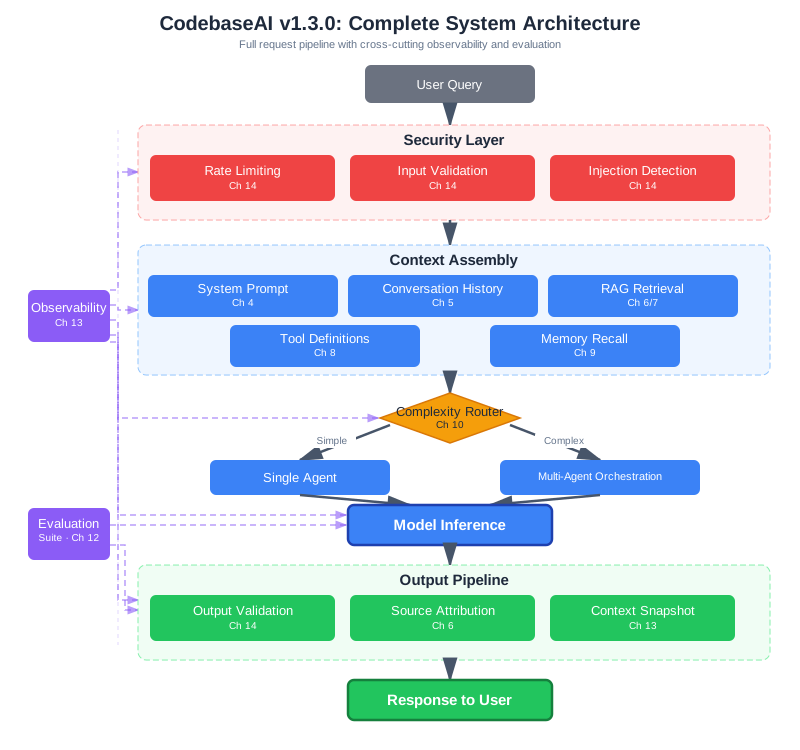
Each box maps to a chapter. Each connection represents a design decision you understand well enough to change, replace, or debug. That’s the real test of understanding—not whether you can build it once, but whether you can modify it confidently when requirements change.
The Journey in Versions
CodebaseAI evolved through fourteen chapters. Each version added capability and taught a principle:
v0.1.0 (Chapter 1): Paste code, ask a question. It worked sometimes. You learned that AI systems have inputs beyond your message—there’s a whole context window you weren’t thinking about.
v0.2.0 (Chapter 2): Token tracking and context awareness. You hit the wall, watched responses degrade as context grew, and learned that constraints shape design. Every system has limits; engineers work within them.
v0.3.0 (Chapter 3): Logging, version control, test cases. You stopped debugging by intuition and started debugging systematically. When something breaks, you get curious, not frustrated.
v0.4.0 (Chapter 5): Multi-turn conversation with sliding windows and summarization. You learned that state is the enemy—manage it deliberately or it manages you.
v0.5.0 (Chapter 6): RAG pipeline with vector search. You gave the AI access to information it wasn’t trained on. You learned about data architecture, indexing, retrieval—patterns engineers have used for decades.
v0.6.0 (Chapter 7): Cross-encoder reranking and evaluation metrics. You learned to measure before optimizing. Intuition lies; data reveals.
v0.7.0 (Chapter 8): Tool use with file reading, code search, test running. You learned interface design and error handling. Design for failure—every external call can fail.
v0.8.0 (Chapter 9): Persistent memory with privacy controls. You learned about persistence, database design, and the responsibility that comes with storing user data.
v1.0.0 (Chapter 10): Multi-agent coordination with specialized roles. You learned distributed systems thinking—coordination is hard, failure modes multiply, simplicity wins.
v1.1.0 (Chapter 11): Production deployment with rate limiting and cost controls. You learned that production is different from development. Test in production conditions, not ideal conditions.
v1.2.0 (Chapter 13): Observability with traces, metrics, and context snapshots. You learned that good logs are how you understand systems you didn’t write.
v1.3.0 (Chapter 14): Security hardening with defense in depth. You learned that security isn’t a feature—it’s a constraint on every feature.
What the Versions Add Up To
Look at the version history again—not as a list of features, but as a pattern. Early versions solved single problems: paste code, track tokens, add logging. Later versions solved interaction problems: how retrieval and conversation history compete for tokens (v0.5.0 + v0.6.0), how multi-agent coordination creates new failure modes that observability must catch (v1.0.0 + v1.2.0), how security constraints shape every other component (v1.3.0 touching everything before it).
The progression isn’t linear feature accumulation. It’s the recognition that real systems are interacting concerns—and that the engineering discipline needed to manage those interactions is what separates production software from prototypes. This is the deep lesson of the CodebaseAI journey: each technique is straightforward in isolation, and the real engineering challenge is making them work together reliably.
Could You Rebuild It?
Here’s a test: Could you build CodebaseAI from scratch? Not copy the code, but design and implement it yourself, making the architectural decisions, handling the edge cases, building the testing infrastructure?
If you can say yes—not “maybe” or “probably” but yes, with confidence—then something important has happened. You’re not someone who followed a tutorial. You’re an engineer who understands the system deeply enough to recreate it.
That’s the difference between knowing how to use tools and understanding how to build systems.
What You Actually Learned
Not a list of techniques, but a transformation in how you think about AI systems.
The Shift in Thinking
You used to add more context when the model got confused. Now you measure attention budget, understand where critical information sits in the window, and trim strategically. You diagnose attention problems instead of hoping more data helps.
You used to hope your retrieval found relevant documents. Now you build evaluation pipelines that measure recall and precision. You know what “good retrieval” means for your use case, not just assuming relevance scores indicate truth.
You used to treat AI failures as prompt problems—maybe the wording wasn’t clear enough, maybe you need to ask more politely. Now you diagnose context, position, and information architecture. You know that “the model gave a bad answer” doesn’t describe the problem; “the retrieved documents had low relevance scores and the system prompt was positioned where attention is weak” describes what actually happened.
You used to manage conversation memory by keeping everything and hoping the model would focus on what mattered. Now you deliberately choose what to preserve—key decisions, important facts, progress markers—and compress or discard the rest. You understand that more memory creates more context debt, not more intelligence.
You used to give models tools and hope they’d use them correctly. Now you design clear interfaces, validate inputs, check outputs, and gate dangerous actions. You know that tool use is an attack surface you must defend, not a convenience feature.
You used to build systems for the happy path. Now you design for failure—every external call can fail, every model response can be wrong, every user might be adversarial. Your designs handle what goes wrong, not just what goes right.
You used to evaluate by asking “does it look right?” Now you build datasets, run automated tests, measure quality scores, and track changes over time. You know what good performance means and when you’ve achieved it.
You used to debug by adding logging and rerunning the query. Now you pull context snapshots, examine traces, compare successful and failed requests, and systematically narrow down root causes. You understand systems instead of guessing at fixes.
You used to deploy when it seemed ready. Now you understand production constraints, implement rate limiting, monitor quality metrics, and have plans for when things degrade. You know that production is different from development, and you prepare for that difference.
You used to hope security would happen. Now you implement defense in depth—multiple layers, each catching what others miss. You assume adversarial users exist and design accordingly. You understand that every capability is an attack surface.
What Enabled the Shift
These transformations didn’t come from learning techniques. They came from internalizing an engineering discipline:
Measurement over intuition: You can’t improve what you can’t measure. Every design decision you now make is informed by data about what actually happens, not what you assume happens.
Systematic over reactive: When something breaks, you don’t guess. You form hypotheses, test them, narrow down causes. You treat failures as information about the system, not as random bad luck.
Explicit over implicit: State is managed deliberately. Constraints are named and designed for. Decisions are documented and reasoned about. What used to happen accidentally now happens on purpose.
Layers over silver bullets: You stopped looking for the one thing that would fix everything. You built systems with multiple layers of defense, each catching what others miss. This applies to security, reliability, testing, everything.
Production-ready from the start: You don’t build for the happy path and hope it works in production. You build for production constraints from the beginning—monitoring, graceful degradation, cost awareness, failure handling.
Software Engineering Principles
But the context engineering techniques are only half of what you learned. The other half—arguably the more valuable half—is transferable software engineering:
Systems thinking: Any complex thing you build is a system with inputs, outputs, and internal state. Understanding the system means understanding how components interact, where state lives, and how information flows.
Constraint-driven design: Every system has limits. Memory, bandwidth, context windows, API quotas, user patience. Engineers work within constraints, making them explicit and designing around them.
Systematic debugging: When something breaks, you don’t guess. You form hypotheses, gather evidence, test predictions, and narrow down causes. This is the scientific method applied to code.
API contract design: Interfaces between components should be clear, documented, and stable. A system prompt is an interface. A tool definition is an interface. Good interfaces make systems maintainable.
State management: State is where bugs hide. The more state, the more ways things can go wrong. Minimize state, make it explicit, manage transitions carefully.
Data architecture: How you organize information determines how effectively you can retrieve it. This applies to vector databases, SQL databases, file systems, and any other storage.
Performance optimization: Measure first. Identify the actual bottleneck. Optimize that. Repeat. Don’t optimize based on intuition—measure and prove.
Interface design: The boundary between components should be clear. What goes in, what comes out, what can go wrong. Clear interfaces enable independent development and testing.
Persistence patterns: Data that survives restarts is different from data that doesn’t. Understanding when to persist, how to persist, and what consistency guarantees you need is fundamental.
Distributed coordination: When multiple components need to work together, you need to think about ordering, failure modes, and partial failures. This applies to microservices, multi-agent systems, and any distributed architecture.
Production readiness: Development and production are different environments with different constraints. Testing in development doesn’t guarantee success in production.
Testing methodology: Different types of tests serve different purposes. Unit tests, integration tests, end-to-end tests, evaluation suites—each catches different categories of problems.
Observability: You can’t improve what you can’t measure. You can’t debug what you can’t see. Logging, metrics, and tracing aren’t overhead—they’re how you understand systems in production.
Security mindset: Assume adversarial users exist. Build multiple layers of defense. Fail safely. Never trust input.
These principles transfer to everything you’ll ever build. The context engineering techniques might be superseded by better tools. The engineering principles won’t.
The Engineering Habits
Throughout this book, each chapter ended with an engineering habit—a practice that separates systematic engineering from intuitive building. Collected together:
-
Before fixing, understand. Before changing, observe. Don’t jump to solutions. Understand the problem first.
-
Know your constraints before you design. Make limits explicit. Design within them.
-
When something breaks, get curious, not frustrated. Failures are information. They tell you something about the system you didn’t know.
-
Treat prompts as code—version them, test them, review them. Prompts are part of your system. They deserve the same rigor as code.
-
State is the enemy; manage it deliberately or it will manage you. Minimize state. Make it explicit. Manage transitions carefully.
-
Don’t trust the pipeline—verify each stage independently. Complex systems fail in complex ways. Test each component.
-
Always measure. Intuition lies; data reveals. Don’t assume you know what’s slow or what’s broken. Measure and prove.
-
Design for failure. Every external call can fail. Networks fail. APIs fail. Models fail. Handle it.
-
Storage is cheap; attention is expensive. Be selective. Store liberally. Retrieve carefully. Not everything stored should enter the context.
-
Simplicity wins. Only add complexity when simple fails. Start simple. Add complexity only when simple approaches demonstrably fail.
-
Test in production conditions, not ideal conditions. Development environments lie. Test under realistic load, realistic data, realistic users.
-
If it’s not tested, it’s broken—you just don’t know it yet. Untested code is broken code waiting to be discovered.
-
Good logs are how you understand systems you didn’t write. Future you, or the engineer on call at 3 AM, needs to understand what happened. Log for them.
-
Security isn’t a feature; it’s a constraint on every feature. Every capability is an attack surface. Evaluate every feature through a security lens.
These habits aren’t AI-specific. They’re how engineers think. They’ll serve you regardless of what technologies emerge or fade.
Speaking the Language
Something subtle happened as you worked through this book: you acquired vocabulary.
Before, when your AI gave a bad answer, you might have said “it’s confused” or “it’s not understanding me.” Those descriptions feel true but aren’t actionable. They don’t point toward fixes.
Now you can say:
“The context window is saturated—the retrieval is returning too many documents and the critical information is getting lost in the middle.”
“Retrieval precision is low—we’re finding documents that contain the keywords but aren’t semantically relevant to the query.”
“There’s token budget pressure—the conversation history is consuming 60% of the window before we even add retrieval.”
“The system prompt isn’t being followed—it’s too long and the instructions are positioned where the model doesn’t attend to them strongly.”
“This looks like indirect injection—there’s instruction-like content in the retrieved documents that the model is following.”
This vocabulary matters because it enables collaboration. When you can name the problem precisely, you can discuss solutions precisely. When you share vocabulary with other engineers, you can work together effectively.
You can now participate in technical discussions about AI systems. You can review other engineers’ code and provide meaningful feedback. You can explain your architectural decisions and defend them with reasoning.
Working with Others
Engineering is collaborative. The systems that matter are built by teams, not individuals. If you’ve been building solo—as many vibe coders do—this section is especially important. The transition from solo builder to team contributor is one of the most valuable things context engineering prepares you for.
What Good AI Code Looks Like
When other engineers review your AI code, they should see:
Structure: Clear separation between retrieval, assembly, inference, and post-processing. Components that can be understood, tested, and modified independently.
Documentation: Not just what the code does, but why. Especially for prompts—why is this instruction here? What failure mode does it prevent? What did you try that didn’t work?
Tests: Evaluation suites that measure quality. Regression tests that catch when changes break things. Tests that run automatically on every change.
Logging: Traces that tell the story of a request. Enough detail to debug without so much noise that signal is lost. Correlation IDs that connect logs across components.
Versioning: Prompts tracked in version control. Configuration changes reviewed and reversible. The ability to roll back when something goes wrong.
This isn’t overhead. It’s how professional software is built. It’s what enables teams to work together on systems that are too complex for any individual to hold in their head.
Code Review: Giving and Receiving
Code review is where team engineering actually happens. It can feel uncomfortable at first—someone scrutinizing your work, questioning your choices. But it’s one of the most effective learning mechanisms in software development.
As a reviewer, focus on these things in AI system code: Does the system prompt change make sense? Is there a test covering the new behavior? Are the error paths handled? Is there logging sufficient to debug this in production? Does the context assembly respect the token budget? These are the questions that catch real problems.
As the author, your job is to make the reviewer’s life easy. Write pull request descriptions that explain why you made the change, not just what you changed. If you modified a system prompt, explain the failure mode you observed and why this wording addresses it. If you changed retrieval parameters, show the evaluation results before and after. The engineering habit—measure before and after—makes your PRs compelling.
A common pattern for AI system PRs:
## What changed
Modified the system prompt to add explicit citation instructions.

## Why
Users reported responses that made claims without referencing
specific files. Evaluation showed 34% of responses lacked
source citations.

## Evidence
Ran evaluation suite on 200 queries:
- Citation rate: 66% → 91%
- Answer quality score: 0.82 → 0.84 (no regression)
- Hallucination rate: unchanged at 3.2%

## Risk
Low. Change is additive (new instruction, no removal).
Rollback: revert to prompt v2.3.1.
This kind of PR gets approved quickly because it shows the engineer understands what they changed and why. It demonstrates the engineering mindset.
Explaining AI-Assisted Code
If you used AI tools to write your code—and in 2026, most developers do—you may face questions from colleagues about the quality and reliability of AI-generated code. Here’s how to handle this effectively.
First, own the code completely. Whether you wrote it by hand, generated it with Cursor, or paired with Claude Code, it’s your code once you commit it. You’re responsible for understanding it, testing it, and maintaining it. “The AI wrote it” is never an acceptable explanation for a bug. This might sound obvious, but it’s a common pitfall for developers early in the AI-assisted workflow.
Second, focus on what matters: does the code work, is it tested, and is it maintainable? If you can answer yes to all three—and you can demonstrate it with tests, evaluations, and clear documentation—then how it was produced is irrelevant. The engineering discipline you’ve learned ensures that AI-assisted code meets professional standards regardless of its origin.
Third, be transparent about your workflow without being defensive. “I used Claude Code to generate the initial implementation and then refined the error handling and added the edge case tests myself” is a perfectly professional description. It’s not different in principle from “I adapted the pattern from a Stack Overflow answer and customized it for our use case.”
Joining a Team
If you join a team building AI systems, here’s what to expect—and what will differentiate you from other candidates.
The market has shifted dramatically. In 2025, AI engineer was ranked the #1 “Job on the Rise” on LinkedIn, with industry compensation data showing 88% growth in new AI/ML hires (as of early 2026; verify current trends). But the nature of these roles has changed too: the majority of AI job listings now seek domain specialists rather than generalists. “Prompt engineer” as a standalone role has largely been absorbed into broader AI engineering roles—IEEE Spectrum reported in 2025 that models had become too capable to require dedicated prompt crafters, and the engineering work had shifted from phrasing requests to designing information environments. What replaced it is what you’ve been learning: the ability to design, build, debug, and maintain AI systems with engineering discipline.
On a team, prompt changes go through code review. Someone else reads your changes, asks questions, suggests improvements. This isn’t bureaucracy—it’s how teams catch mistakes before they reach production. Companies like Vercel use an RFC (Request for Comments) process for architectural decisions and a three-layer code review strategy: human design at the component level, AI-assisted implementation with automated testing and human review, and human-led integration at system boundaries.
Configuration changes are tracked and reversible. When something breaks, you can look at what changed and roll it back. This is where the engineering habits pay off—a team that versions its prompts, evaluates changes with data, and documents decisions can move fast without accumulating the kind of technical debt that slows teams down later.
Incidents are investigated and documented. When something goes wrong in production, the team doesn’t just fix it—they understand why it happened and how to prevent it from happening again.
There’s shared understanding of the architecture. Team members can explain the system to each other. They know where to look when something goes wrong. They can make changes without breaking things they didn’t know existed. Teams that define clear boundaries for AI assistance versus human oversight consistently report better outcomes. Notion’s approach—keeping architectural decisions, security-critical components, and performance-critical paths under human supervision while using AI tools for implementing clear algorithms and converting design specs—reportedly achieved significant productivity gains while maintaining quality standards.
Quality is measured, not just asserted. There are metrics that tell you whether the system is working well. When you make changes, you can see whether they helped.
Contributing to Existing Codebases
Most professional engineering isn’t greenfield. You’ll inherit systems built by people who aren’t around to explain their decisions. This is where your engineering training pays off most directly.
When you encounter an unfamiliar AI system, apply the same diagnostic approach you’d use with CodebaseAI: examine the system prompt to understand what the system is supposed to do. Check the retrieval pipeline to understand where information comes from. Look at the logging to understand what’s being tracked. Run the test suite to understand what behavior is protected. Read the incident history to understand what has gone wrong before.
This is exactly the systematic investigation process from Chapter 3. It transfers directly from “debugging your own system” to “understanding someone else’s system.” The engineering mindset is portable.
This is what professional engineering looks like. It’s what you’re now equipped to participate in.
Organizing Teams Around Context Engineering
Context engineering isn’t a solo discipline. As systems scale, teams need coordination around the shared resources that shape AI behavior.
Who Owns What
In a typical AI product team, context engineering responsibilities spread across roles:
Prompt engineers or AI engineers own system prompts, few-shot examples, and output format specifications. They need version control, A/B testing infrastructure, and clear approval workflows for prompt changes—because a prompt change can shift system behavior as dramatically as a code change.
Data engineers own the RAG pipeline: ingestion, chunking, embedding, and indexing. They need monitoring for index freshness, embedding quality, and retrieval performance. A stale index or bad chunking strategy affects every user.
Platform engineers own the infrastructure: rate limiting, cost controls, model fallback chains, and observability. They provide the guardrails that keep context engineering decisions from causing production incidents.
Security engineers own the defense layers: input validation, output filtering, context isolation, and action gating. They review prompt changes for security implications, just as they’d review code changes.
The Prompt Review Process
Treat prompt changes like code changes:
- Version control: Every prompt lives in git, with semantic versioning
- Review process: Prompt changes require peer review—ideally by someone who’ll look at the evaluation results, not just the text
- Testing: Run evaluation suite before and after. No prompt ships without regression testing
- Staged rollout: Deploy to a percentage of traffic first, monitor quality metrics, then expand
- Rollback plan: Every prompt deployment must be instantly reversible
Shared Context Contracts
When multiple teams contribute to the same context window—one team manages the system prompt, another manages RAG retrieval, a third handles conversation history—they need explicit contracts:
- Token budgets per component: Each team gets an allocation (see Appendix D, Section D.4). Going over budget requires cross-team negotiation.
- Format specifications: Retrieved documents must follow agreed formatting. Changing the format without coordination breaks downstream prompts.
- Testing responsibilities: Each team tests their component in isolation AND in integration. The context window is a shared resource; changes in one component affect all others.
The teams that do this well treat context engineering like API design: clear contracts, versioned interfaces, and explicit ownership boundaries.
What Context Engineering Doesn’t Solve
This book taught you context engineering as a discipline. It’s genuinely powerful—probably the single highest-leverage skill for building reliable AI systems today. But intellectual honesty requires acknowledging its limits.
Context engineering can’t fix a model that doesn’t have the underlying capability. If a model can’t reason about complex code, no amount of context optimization will make it a great code reviewer. If a model hallucinates confidently about topics outside its training data, better retrieval reduces but doesn’t eliminate the problem. The model’s base capabilities set a ceiling; context engineering determines how close you get to that ceiling.
Context engineering can’t guarantee safety in adversarial environments. Chapter 14 taught you defense in depth, but the honest truth is that prompt injection remains an unsolved research problem. Your defenses raise the bar for attackers significantly, but a sufficiently motivated and creative adversary will find gaps. This is why defense in depth matters—not because any single layer is perfect, but because layers in combination make attacks dramatically harder.
Context engineering can’t replace domain expertise. You can build a medical information system with excellent retrieval and careful prompt design, but you can’t evaluate whether its medical advice is correct without medical knowledge. Context engineering is a development discipline, not a substitute for understanding the domain your system operates in.
Context engineering isn’t always the right tool. Sometimes fine-tuning is a better choice—particularly when you need the model to internalize specialized language patterns (legal terminology, medical concepts, domain-specific jargon) rather than retrieving them at inference time. Fine-tuning creates a model that “thinks” in your domain’s language, which RAG-based context engineering can’t replicate. The tradeoff: fine-tuning is more expensive to create and harder to update, while context engineering through RAG is cheaper to operate and allows immediate knowledge updates. The best production systems often combine both—a fine-tuned model that understands domain fundamentals, augmented with RAG for current information. Knowing when to use which approach, or when to combine them, is itself an engineering judgment that context engineering alone doesn’t teach.
And context engineering can’t make AI systems fully predictable. Even with perfect context, models are probabilistic. The same input can produce different outputs. The techniques in this book reduce variance dramatically—good system prompts, evaluation suites, regression tests all narrow the distribution of outputs. But they don’t eliminate variance entirely. Engineering with probabilistic systems requires accepting and managing uncertainty rather than eliminating it.
None of this diminishes the value of what you’ve learned. It means you should apply it with clear eyes. Context engineering is necessary but not sufficient for production AI systems. It’s the deepest lever you have—but it works best when combined with domain expertise, healthy skepticism about model capabilities, and ongoing investment in safety research.
The Unsolved Problems
Beyond the limits of context engineering as a technique, there are problems the field as a whole hasn’t solved yet. Being aware of these is part of engineering maturity—you should know where the frontier is, not just what’s behind you.
Evaluation remains fundamentally hard. We can measure whether retrieval finds relevant documents. We can measure whether outputs match expected patterns. But measuring whether an AI system’s response is good—helpful, accurate, appropriately caveated, and safe—still relies heavily on human judgment. LLM-as-judge approaches (Chapter 12) help scale evaluation, but they inherit the biases and blind spots of the models doing the judging. There is no equivalent of “the test suite passes” for AI system quality.
Multimodal context is largely uncharted territory for engineering discipline. This book focused on text-based context because that’s where the field is most mature. But models increasingly process images, audio, and video as context. The same engineering questions apply—what information does the model need? How do we select and organize it?—but the tooling, measurement, and best practices for multimodal context engineering are still developing.
Long-running agent reliability is an open problem. Chapter 10 introduced multi-agent coordination, but agents that run autonomously for hours or days—maintaining coherence, recovering from failures, managing their own context across hundreds of tool calls—push beyond what current techniques handle reliably. The compound engineering approach (systematic learning from each iteration) points in the right direction, but we don’t yet have robust patterns for truly autonomous long-duration agents.
And alignment between AI system behavior and human values remains an active research area. Context engineering can constrain what a model does through system prompts, guardrails, and output validation. But ensuring that an AI system consistently acts in its users’ best interests—especially in novel situations the designers didn’t anticipate—requires advances that go beyond what application developers can implement alone.
These aren’t reasons for pessimism. They’re the problems that will define the next generation of AI engineering. And the discipline you’ve learned—systematic investigation, measurement before optimization, building in layers, failing safely—is exactly the foundation needed to contribute to solving them.
The Path Forward
This book taught you context engineering as of early 2026. The field will continue to evolve. Here’s how to keep growing—with specific guidance depending on where you’re heading.
Three Learning Paths
If you’re joining a team as a software engineer: Your immediate priorities are git workflow proficiency (branching, rebasing, conflict resolution), code review practices, and familiarity with CI/CD pipelines. The engineering principles from this book—systematic debugging, testing methodology, observability—translate directly, but the team practices around them are skills in themselves. Start contributing with small, well-tested changes. Build trust by demonstrating the engineering discipline: your PRs have evaluation data, your changes have rollback plans, your incidents get documented. Within a few months, you’ll be the person others come to for AI system questions. Keep in mind that many teams are adopting AGENTS.md files—the open specification for guiding coding agents—as standard project documentation alongside READMEs. Understanding how to write and maintain these files is a practical skill that connects directly to what you’ve learned about system prompts and context design.
If you’re building an AI startup: Your priorities are different. Speed matters, but so does building systems that can evolve as you learn from users. Start with the simplest architecture that could work (Chapter 11’s advice), add evaluation infrastructure early (Chapter 12), and instrument everything (Chapter 13). The most common startup mistake with AI systems is building complex multi-agent architectures before validating that users want the product at all. Context engineering lets you start simple and add complexity in response to real needs, not anticipated ones. Pay special attention to cost management—token costs have been falling rapidly (as of early 2026; verify current pricing), but unit economics still matter at scale. Many AI startups discover their margins don’t work because they didn’t think about token costs, caching strategies, and graceful degradation early enough. Over half of Y Combinator’s recent batches (as of early 2026) have focused on agentic AI—if you’re building in this space, your context engineering discipline is a genuine competitive advantage, because when everyone has access to the same models, the quality of your context assembly is what differentiates your product.
If you’re going deeper on ML and research: This book deliberately stayed at the application layer—how to use models effectively rather than how models work internally. The natural next step is understanding what happens inside the model: attention mechanisms, transformer architecture, fine-tuning, and training dynamics. This knowledge helps you understand why certain context engineering strategies work and predict what will work before trying it. Start with fast.ai’s Practical Deep Learning for Coders—it takes a code-first approach that will feel natural after this book, and includes building Stable Diffusion from scratch. The Hugging Face LLM Course covers fine-tuning and reasoning models with the same hands-on philosophy. For deeper theory, Stanford’s CS229 provides the mathematical foundations. Your context engineering experience gives you an advantage that pure theorists don’t have—you already understand the failure modes that theory alone doesn’t reveal.
Continuing to Learn
Read primary sources. Papers, documentation, official announcements. Summaries and tutorials are useful, but primary sources contain nuance that gets lost in translation. The Hugging Face trending papers page surfaces the most impactful new research daily. For deeper dives, arXiv’s cs.CL (Computation and Language) and cs.LG (Machine Learning) sections are where breakthroughs appear first. Andrew Ng’s The Batch newsletter provides authoritative weekly context on what matters and what doesn’t.
Build things. Reading about building isn’t building. Every project teaches you something that theory can’t. Build things that interest you. Build things that are slightly beyond your current ability.
Contribute to open source. The Model Context Protocol (MCP) ecosystem is growing rapidly and welcomes new server implementations and integrations—it’s a natural extension of the tool use concepts from Chapter 8. LangChain and LlamaIndex both have active communities and beginner-friendly issues. Contributing to these projects exposes you to production patterns from experienced engineers and builds your professional reputation in the field.
Join a community. The AI engineering community has matured beyond scattered forums into substantive spaces for practitioners. The Latent Space newsletter and podcast (founded by swyx) focuses specifically on AI engineering—not research hype, but the practical work of building systems. The Learn AI Together Discord (90,000+ members as of early 2026) provides active peer support and collaboration. The annual AI Engineer Conference has become the largest technical gathering in this space.
Share what you learn. Writing clarifies thinking. Teaching reinforces understanding. When you explain something, you discover gaps in your own knowledge.
Stay skeptical of hype, but open to paradigm shifts. Most “revolutionary” announcements don’t change much. Some do. Learn to distinguish signal from noise while remaining open to genuine advances.
What’s Coming
The AI development landscape will look different in two years. Some directions are already visible.
The agentic engineering era. AI agents that autonomously plan, execute, test, and iterate are becoming the professional standard. As Karpathy observed in his 2025 review: “You are not writing the code directly 99% of the time… you are orchestrating agents who do and acting as oversight.” The context engineering discipline you’ve learned is the foundation—agents are only as reliable as the context they work with. Every technique in this book applies directly to building and orchestrating agents.
Compound engineering. There’s a pattern emerging in teams that successfully adopt AI-assisted development: each unit of engineering work makes subsequent units easier, like compound interest. Learnings from one iteration get codified into agent context—through AGENTS.md files, through improved evaluation suites, through documented failure modes. Teams following this pattern report 25-35% faster workflows than sequential alternatives. But here’s the critical insight: compound engineering only works when you have the infrastructure to capture and apply learnings. Without systematic debugging (Chapter 3), evaluation suites (Chapter 12), and observability (Chapter 13), the feedback loop breaks. The engineering discipline this book taught isn’t just good practice—it’s what enables compound productivity.
The quality imperative. The “Speed at the Cost of Quality” study (He, Miller, Agarwal, Kästner, and Vasilescu, 2025, arXiv:2511.04427)—analyzing large-scale open-source commit data—found that AI coding tools increase velocity but create persistent increases in code complexity and technical debt. That accumulated debt subsequently reduces future velocity, creating a self-reinforcing cycle. The teams that escape this cycle are the ones that invested in quality infrastructure: testing, evaluation, code review, observability. This is the context engineering thesis in action—engineering discipline isn’t overhead, it’s what makes speed sustainable.
Context engineering as explicit development practice. The idea that your AI development tools need deliberate context is becoming formalized. The AGENTS.md specification—stewarded by the Agentic AI Foundation under the Linux Foundation—provides a standard way to give AI coding agents project-specific context. The .cursorrules and CLAUDE.md conventions serve the same purpose for specific tools. Geoffrey Huntley’s Ralph Loop methodology treats context management as the central development discipline: reset context each iteration, persist state through the filesystem, plan 40% of the time. These aren’t niche practices—they reflect a growing recognition that the quality of what your AI tools can see determines the quality of what they produce.
Longer context windows, same engineering questions. Models will support more tokens. But more context doesn’t automatically mean better results. The principles of selection, organization, and positioning will matter more, not less. You’ll still need to decide what information the model needs and how to provide it effectively.
Broader tool ecosystems. The Model Context Protocol (MCP) and similar standards are making it possible to connect AI systems to virtually any data source or tool. Models will become more capable at using these tools autonomously. But the principles of interface design, error handling, and security will remain constant.
The constant. Whatever changes, AI systems will still be systems. They’ll have inputs and outputs. They’ll have failure modes. They’ll need testing, monitoring, and debugging. The engineering discipline you’ve learned transfers—whether you’re building a single agent or orchestrating dozens.
Building Your Own Patterns
You’ve learned patterns from this book. Now develop your own.
Notice what works in your specific domain. Document patterns that help your team. Contribute your discoveries back to the community. Teach others what you’ve learned.
The engineers who advance the field aren’t just practitioners—they’re observers and communicators. They notice patterns, articulate them, and share them. You’re now equipped to be one of them.
The Final Test
Here’s what’s changed about what you can do.
Before this book, you could build things with AI. Now you can build things with AI and understand why they work, diagnose them when they don’t, scale them for production, and collaborate with other engineers who need to work on the same systems.
You’re an AI engineer—someone who builds reliable AI systems with the discipline to make them work in the real world. Not defined by any single tool or methodology, but by the depth of understanding you bring to whatever you build.
The Ultimate Metric
Throughout this book, we’ve held a simple standard: “Can they build AI systems that work reliably, and can they explain why?”
This translates to real capability:
Can you design systems, not just write code? Can you think about architecture, trade-offs, and long-term maintainability?
Can you explain your decisions to other engineers? Can you articulate why you made the choices you made, and respond thoughtfully to questions?
Can you debug systematically when things go wrong? Can you move from “it’s broken” to “here’s why and here’s the fix”?
Can you work as part of a team? Can you collaborate, review code, give and receive feedback, and contribute to shared understanding?
Can you learn new technologies when the field changes? Can you pick up new tools, frameworks, and approaches without starting from scratch?
If you can honestly say yes to these questions, you have the engineering discipline that this field demands. Whether you’re vibe coding a prototype, building an agentic pipeline, or debugging a production system at 3 AM—you have the depth to handle it.
And here’s what may be the most practical insight of all: these skills apply in two directions simultaneously. You can build reliable AI systems—designing the context that makes your AI products work. And you can use AI tools more effectively to build any software—because you understand that what Cursor, Claude Code, or Copilot can see determines what they can produce. When you write a .cursorrules file, you’re writing a system prompt. When you structure a project so AI tools can navigate it, you’re doing information architecture. When you follow the Ralph Loop and reset context each iteration, you’re applying conversation history management to your development workflow. The complete AI engineer understands context engineering in both directions—and that’s a rare and valuable combination.
The journey through this book wasn’t about leaving vibe coding behind. It was about adding the engineering discipline that makes you effective at any scale—from weekend project to production system, from solo builder to team contributor.
The Engineering Habit
Never stop learning. The field will change; engineers adapt.
AI development will look different in two years than it does today. Models will be more capable. Tools will be more sophisticated. Some of what you learned in this book will be automated away.
But the engineering discipline—systems thinking, systematic debugging, careful design, thorough testing, security consciousness—won’t become obsolete. These are fundamentals that have defined good engineering for decades. They’ll still define it when AI tools are dramatically more powerful than today.
As AI tools grow more powerful, the engineers who understand context—who can design what information reaches the model, debug when things go wrong, and build systems that work reliably—will be the ones building the most ambitious things. Depth is the multiplier.
You’ve invested in depth. Keep investing.
Context Engineering Beyond AI Apps
Throughout this book, every chapter included a bridge to AI-driven development—showing how the technique you learned for building AI systems applies equally to how you use AI to build any software. This wasn’t an afterthought. It’s one of the book’s core arguments: context engineering is the discipline that makes AI-driven development reliable, regardless of what you’re building.
The evidence supports this. The CodeRabbit study found AI-generated code has 1.7x more issues and 2.74x more security vulnerabilities. The “Speed at the Cost of Quality” study found AI coding tools increase velocity but create persistent complexity. These aren’t arguments against using AI—they’re arguments for understanding context engineering. When you provide better context to your development tools—through project structure, configuration files, spec-driven workflows, and deliberate session management—the quality gap narrows dramatically.
The developers who will thrive in the agentic engineering era are those who understand context engineering in both directions. They’ll build AI products where the context assembly is so well-designed that the system works reliably. And they’ll use AI tools so effectively—because they understand what those tools need to see—that their development velocity comes without the usual quality cost.
You now have that understanding. Every technique in this book—from system prompts to RAG to testing to security—has a direct parallel in your development workflow. The discipline is the same. The principles transfer. And the combination of both applications makes you more valuable than someone who knows only one.
Summary
This book started with a problem you recognized: “My AI works sometimes but I don’t understand why.” It ends with understanding—of context engineering techniques, software engineering principles, and the engineering mindset that connects them.
The journey: Fourteen chapters. Fourteen versions of CodebaseAI. Fourteen engineering habits. From “paste code and ask a question” to a production-ready system with retrieval, tools, memory, multi-agent coordination, testing, observability, and security.
What you added: Understanding of why things work, not just that they work. Systematic debugging instead of trial-and-error. The ability to collaborate, explain decisions, and build for production. The core competency—context engineering—for the agentic engineering era.
The skills: Context engineering techniques that let you build reliable AI systems. Software engineering principles that transfer to everything you’ll build.
The path forward: Continue learning. Build things. Contribute. Teach. The field is moving toward agentic engineering, and you have the foundational discipline to move with it.
Engineering Habit
Never stop learning. The field will change; engineers adapt.
You started this book wanting to understand why your AI sometimes failed. You’re ending it as an engineer who builds reliable AI systems—and who has the discipline to handle whatever comes next in this fast-moving field.
That’s not the end of your journey. It’s a foundation for everything you’ll build next.